The "Striver" is amazing
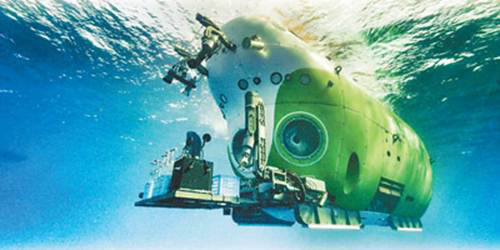
The "Striver" is diving with water. Courtesy of Chinese Academy of Sciences
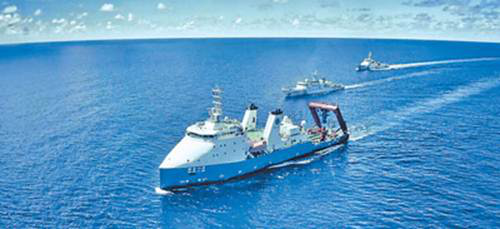
The "Exploration One" ship carrying the "Striver" (previous). Courtesy of Chinese Academy of Sciences
Core Reading
On November 28th, the "Striver" completed its 10000 meter deep-sea trial mission and returned smoothly. Since its launch, the "Striver" has completed 13 dives in the Mariana Trench, with 8 of them breaking 10000 meters and setting a new record for manned deep-sea diving in China at 10909 meters... Behind the constantly breaking numbers are technological breakthroughs in key areas such as pressure resistance, control, communication, and buoyancy, reflecting the breakthrough and progress of China's independent research and development of deep-sea equipment technology.
On November 28th, the "Striver" deep-sea manned submersible successfully completed its 10000 meter deep-sea trial mission and returned to Sanya, Hainan.
On October 10th, the "Striver" set sail from Nanshan Port in Yazhou Bay, Sanya, to conduct a 10000 meter deep diving test mission in the Mariana Trench of the western Pacific Ocean. Afterwards, there were frequent good news along the way——
On October 27th, the dive broke through 10000 meters for the first time; On November 10th, China set a new record for manned deep-sea diving at a depth of 10909 meters; On November 13th, the world's first joint operation of a manned submersible and lander at a depth of 10000 meters was completed, and a live video broadcast was conducted... As of November 19th, the "Striver" has conducted a total of 13 dives in the Mariana Trench, with 8 of them exceeding 10000 meters.
The "Striver", which looks like a green big headed fish, is the first 10000 meter manned submersible in the world that can simultaneously carry three people for diving. Such superb skills can be attributed to its strong "Chinese heart", which has a high degree of localization in multiple key technologies and important material fields, with a core component localization rate of over 96.5%.
High-pressure resistance
A spacious and sturdy manned cabin made of new titanium alloy material
The first challenge to overcome when diving into the depths of thousands of meters is the enormous water pressure. The Mariana Trench, known as the "fourth pole of the Earth," is completely dark and has extremely low temperatures, making it one of the most environmentally harsh regions on Earth. At a depth of 10000 meters in the trench, the water pressure is close to 1100 atmospheres, equivalent to 2000 African elephants stepping on a person's back. How can the "Striver" achieve the ability to walk freely under 10000 meters of sea without fear of high-pressure extreme environments?
The key is the manned cabin. The manned cabin is the core and key component of the deep-sea manned submersible, serving as the hardware guarantee and safety barrier for humans to enter the deep sea of tens of thousands of meters, and also marking the technological level of a country's manned submersible.
The manned cabin of the "Striver" is spherical in shape and can accommodate three underwater pilots at the same time. Previously, some foreign deep-sea submersibles have successfully challenged the pressure of tens of thousands of meters using spherical manned cabins, but the cabin space can only accommodate 1 to 2 people and cannot carry more people and equipment. In order to make the manned cabin of the "Striver" both spacious and sturdy, as well as agile and lightweight enough, researchers have put in a lot of effort.
Yang Rui, a researcher at the Institute of Metal Research of the Chinese Academy of Sciences and the project leader of the manned cabin of the deep-sea manned submersible, said, "As the largest pressure resistant container in the entire submersible, the material used to make the manned cabin is very special, and its success or failure directly affects the success or failure of the entire submersible
Under extreme pressure conditions at a depth of tens of thousands of meters, according to the target size and thickness requirements of the "Striver" submersible, the materials used in the past cannot meet the standards, and a high-strength, high toughness, and weldable titanium alloy needs to be found. There is no precedent for manufacturing internationally, and we cannot find foreign manufacturers to produce. The only way out is for us to make it ourselves, "Yang Rui said.
So, the Institute of Metal Research of the Chinese Academy of Sciences, together with several domestic enterprises and research institutes, formed a "national team" for the development of deep-sea titanium alloy manned cabins. After a series of research and experiments, they overcame a series of key technical bottlenecks such as materials, forming, and welding for manned cabins. Yang Rui said, "Our unique new titanium alloy material Ti62A has successfully solved the problems of strength, toughness, and weldability faced by manned cabin materials
Accurate control
Advanced control system achieves high-precision navigation control
The deep sea is pitch black and the terrain environment is highly complex. To avoid the risk of "hitting the reef", the "Striver" relies on precise command from the control system.
To this end, researchers from the Shenyang Institute of Automation, Chinese Academy of Sciences, have tackled technical challenges such as multi degree of freedom navigation control and safe and reliable operation of large inertia carriers in complex deep-sea environments, enabling the control system of the "Striver" to achieve online intelligent fault diagnosis based on data and model prediction, fault-tolerant control based on online control allocation, and autonomous collision avoidance on the seabed.
Zhao Yang, a researcher at the Shenyang Institute of Automation, Chinese Academy of Sciences and deputy chief designer of the "Striver", said, "Our designed neural network optimization algorithm can enable the" Striver "to automatically match terrain for cruising, fixed-point navigation, and hovering positioning on the seabed. Among them, the performance indicators of horizontal and vertical navigation control have reached the international advanced level
In addition, researchers also equipped the "Striver" with a pair of highly flexible and powerful "hands". The submersible uses two sets of master-slave servo hydraulic robotic arms developed by us to carry out 10000 meter operations. Each set of arms has 7 joints and can achieve 6-degree-of-freedom motion control. It has a carrying capacity of over 60 kilograms and can cover the sampling basket and front work area, demonstrating strong operational capabilities, "said Zhang Qifeng, Deputy Director of the Underwater Robotics Research Laboratory at the Shenyang Institute of Automation, Chinese Academy of Sciences. With these "hands", the "Striver" successfully completed precise tasks such as rock and biological grasping and sediment sampler operation, filling the gap in China's application of full sea depth hydraulic robotic arms for 10000 meter operations.
Thousand mile ears
Underwater acoustic communication system facilitates real-time transmission of underwater sound and image at a depth of 10000 meters
Dear viewers, the ten thousand meter underwater scenery is indescribable. We hope that we can showcase the ten thousand meter underwater scenery to everyone through the footage of the 'Striver'. On November 10th at 8:12 am, the 'Striver' successfully sank into the Mariana Trench, and three submarine crew members immediately shared their feelings through the underwater communication system.
As the only bridge for communication between the "Striver" and the mother ship "Exploration One", this underwater acoustic communication system enables real-time transmission of text, voice, and images from the underwater submersible to the mother ship at a depth of tens of thousands of meters. Compared to the previous two generations of manned submersibles, the "Jiaolong" and "Deep Sea Warrior", the acoustic system of the "Striver" has achieved complete localization. This system was developed under the leadership of the Institute of Acoustics, Chinese Academy of Sciences.
In addition to transmitting sound and images, the acoustic system can also assist the "Striver" in precise operations at depths of tens of thousands of meters underwater. For example, the integrated navigation system consisting of acoustic Doppler velocimeter, positioning sonar, and inertial navigation equipment provides high-precision underwater positioning and navigation for cruise operations.
In the diving operation on November 16th, with the help of a combined navigation system and sonar equipment, the submersible successfully retrieved three underwater samplers previously placed at a depth of tens of thousands of meters in just half an hour, achieving the goal of 'finding a needle from the bottom of the sea', and transmitting the sampling image back to the mother ship through an underwater acoustic communication machine. As one of the submersible crew members of the 'Striver', Liu Yeyao, a senior engineer at the Institute of Acoustics of the Chinese Academy of Sciences, was deeply impressed by this operation. 'The acoustic system of the' Striver 'broke through the difficulty of deep-sea navigation and provided reliable technical support for continuous cruising operations in the entire depth range.'
Strong buoyancy
Solid buoyancy material enables the submersible to return to the surface smoothly
The "Striver" needs to be able to "go down" and "come back", and the key to successfully returning to the water surface is solid buoyancy materials.
The function of solid buoyancy materials is to provide guarantees for the smooth diving and safe surfacing of submersibles. Their performance directly affects the safety of submersibles and divers, and is also a core material for many deep-sea scientific research equipment and the development of marine resources. However, due to the difficulty in preparing high-performance solid buoyancy materials, only a few countries have mastered the technology.
In the absence of literature and experience reference, the Institute of Physical and Chemical Technology of the Chinese Academy of Sciences led the independent research and development of buoyancy materials at the 10000 meter level. Internationally, there have been accidents where underwater equipment has been lost or scrapped due to the cracking and collapse of buoyancy materials. To meet the requirements of repeated deep diving, the technical difficulty of the 'Striver' can be imagined, "said Zhang Jingjie, a researcher at the Institute of Physical and Chemical Technology of the Chinese Academy of Sciences." The core technical problem is to solve the synergistic relationship between material density and strength, which means that it needs to have both low density and high water pressure resistance
On the basis of years of technological accumulation in the early stage, researchers have adopted soft chemistry preparation technology with independent intellectual property rights to develop the core raw materials of solid buoyancy materials in a short period of time, achieving a key technological breakthrough in China's buoyancy material research. Subsequently, after a series of formula adjustments and process optimizations, a 10000 meter level solid buoyancy material with high safety factor was prepared and mass-produced, solving the technical problem of high strength difference and density of domestically produced solid buoyancy materials for a long time.
People's Daily (November 30, 2020, 07 edition)