Teledyne TSS Subsea Pipeline Magnetometer Series
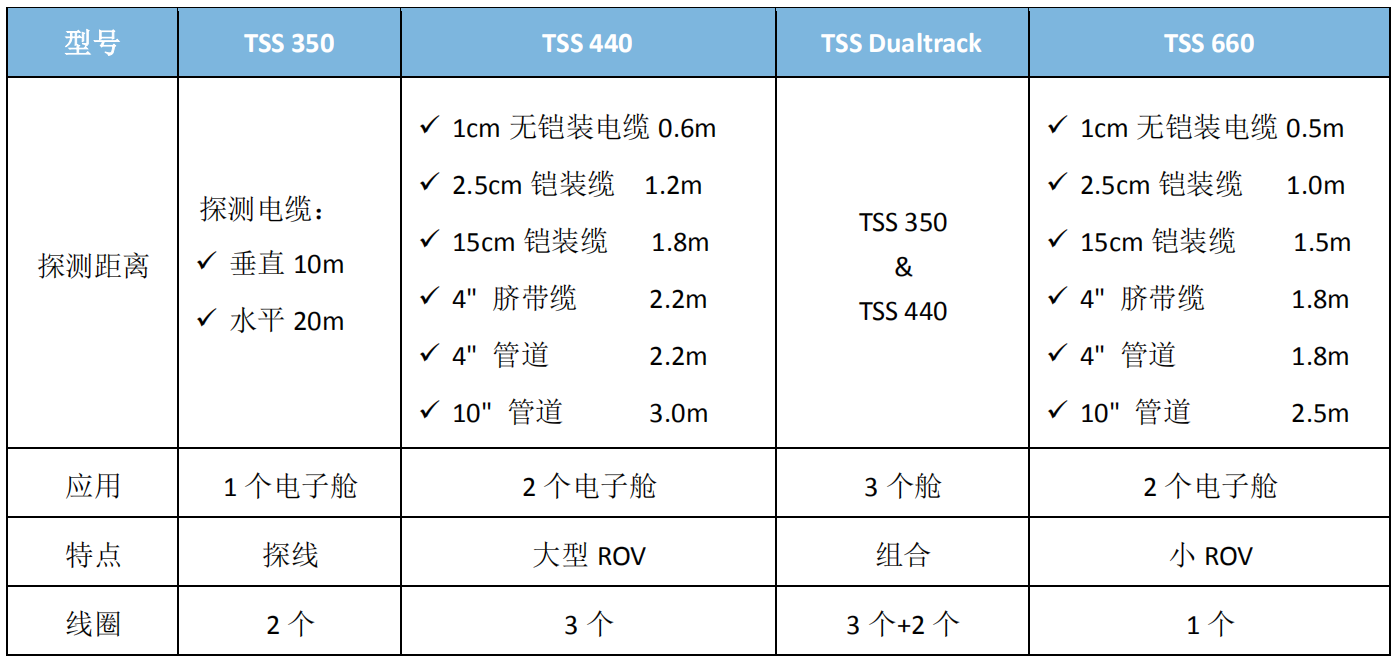
TSS350/TSS440, as specialized underwater cable detection/tracking equipment, has high detection accuracy and continuous detection results. The equipment is installed on the ROV, and the ROV can continuously collect burial depth data by flying along the submarine cable route. At the same time, the collected data can be submitted on site after simple processing, and based on this, the section with insufficient burial depth can be determined and supplemented with excavation. Due to the fact that electromagnetic induction detection is carried out in the direction of parallel pipelines, the operational efficiency is relatively high.


 |
|
|
TSS350 is a submarine cable tracking instrument based on the principle of AC carrier method. When there is AC power in the cable, there must be electromagnetic waves around it. The induction coil receives the corresponding induced electromotive force, and the voltage is inversely proportional to the distance between the cable and the sensor. Based on this principle, the distance between the submarine cable and the coil can be calculated. With the built-in altimeter, the burial depth of the submarine cable can be accurately detected. TSS440 is a cable detection device that uses pulse induction method (metal detection method), including three coils and an altimeter. In an ungrounded circuit, an alternating current is input to generate a changing magnetic field. The underwater metal target induces a secondary magnetic field, and the receiving coil receives the induced voltage corresponding to the secondary magnetic field to determine the distance of the target object. With the help of an altimeter, the burial depth of the underwater cable can be detected. |
✓ Suitable for tracking, burying, and measuring needs of pipelines and cables ✓ Pulse sensing technology enables autonomous operation ✓ Communication tone detection mode, capable of measuring deeper burial depths ✓ Portable system design ✓ Lock the target and search forward mode |
 |
|